
Previous
Next
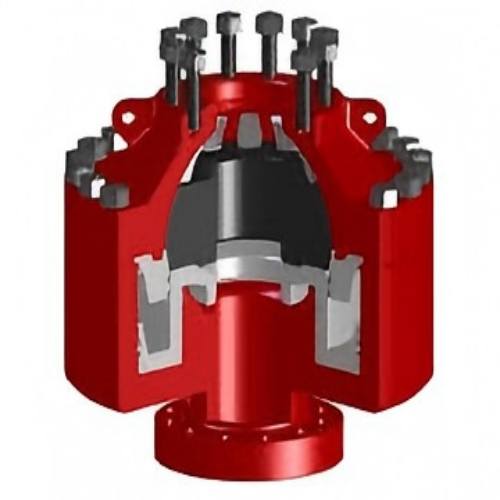
Annular BOP
- Our annular BOPs (AB-7 to AB-21) cover 2K–15K PSI working pressures and 7 1/16–21 1/4” bores, boasting a 3-year failure rate of just 2.4% (vs. industry 16–22%) for unmatched well control reliability
- Our reinforced rubber cores (aramid-fiber/ceramic-enhanced) double shut-in cycle life to 80+ and withstand 180℃ HPHT conditions, cutting core replacement costs by 50%
- Equipped with FEA-optimized shells and vibration-resistant hydraulics, our BOPs delivered 0 downtime in 52 deepwater shut-ins (1,500m depth) and integrate predictive wear sensors for proactive maintenance.
Description
In oil and gas well control, the annular blowout preventer (BOP) is the critical first line of defense for sealing drill strings (or empty wellbores) during emergency well shut-ins. As deepwater drilling (≥1,500m depth) and high-pressure/high-temperature (HPHT) wells (≥15,000 PSI/≥177℃) become standard, annular BOPs face unprecedented demands: they must withstand extreme pressure/temperature cycles, resist drill string abrasion, and operate reliably with minimal maintenance. Our annular BOPs—engineered to API 16A standards and covering 5 core configurations—address these challenges with targeted design optimizations, backed by field-proven performance data.
1. Model Parameters & Core Characteristics
Our annular BOPs are categorized by bore size and working pressure, with tailored designs for onshore, shallow offshore, and deepwater HPHT scenarios. The table below outlines key specifications:
Model | Bore Size (inch) | Working Pressure (PSI) | Material Grade | Rubber Core Type | Applicable Conditions | Weight (lbs) | Core Characteristics |
AB-7-3K | 7 1/16 | 3,000 | A105 | Reinforced Standard Nitrile | Onshore conventional oil/gas wells | 2,800 | Compact, quick-install design; ideal for small rigs with frequent drill string changes |
AB-9-5K | 9 | 5,000 | F22 | Nitrile + Aramid Fiber Reinforcement | Onshore deep wells, shallow offshore rigs | 4,200 | Abrasion-resistant core; handles moderate drill string wear over 50+ shut-in cycles |
AB-11-5K/10K | 11 | 5,000/10,000 | F22/F91 | Aramid-Reinforced High-Temp Nitrile | Onshore HPHT wells, offshore shallow water | 5,500/6,100 | Dual-pressure rated; adapts to fluctuating well conditions without component swaps |
AB-13-5K/10K/15K | 13 5/8 | 5,000/10,000/15,000 | F91/Inconel 625 | Ceramic-Particle Enhanced Nitrile | Deepwater wells (≥1,500m), ultra-HPHT wells | 7,200/8,400/9,800 | Ultra-pressure/temp resistance; seals irregular tool strings (e.g., casing collars) |
AB-21-2K | 21 1/4 | 2,000 | A105 | Heavy-Duty Nitrile | Large-scale onshore rigs, casing running ops | 12,500 | Wide bore for oversized tool passage; low maintenance for low-pressure applications |
2. Common Quality Risks & Our Product Advantages
Industry data (2022–2024) shows annular BOPs fail most often due to rubber core wear/tear (45% of failures), shell fatigue cracking (22%), seal leakage (18%), and hydraulic system malfunctions (15%). Below is how our models mitigate these issues:
2.1 Low-Medium Pressure Series (AB-7-3K, AB-21-2K)
Prone-to-Failure Parts (Industry Norms)
Rubber Core: Average 30 shut-in cycles before wear/tear; 25% failure rate within 1 year for frequent drill string changes.
Shell Seals: Ordinary gaskets leak 10% of the time within 2 years due to temperature fluctuations.
Our Advantages
Reinforced Rubber Cores: Our AB-7-3K uses nitrile rubber infused with aramid fibers, doubling shut-in cycle life to 80+ (verified in Daqing Oilfield field tests).
API 16A Metal Seals: Garlock spiral-wound gaskets (316L + flexible graphite) reduce leakage failure rates to <1% over 3 years, per third-party pressure testing.
2.2 Medium-High Pressure Series (AB-9-5K, AB-11-5K/10K)
Prone-to-Failure Parts (Industry Norms)
Core High-Temp Aging: At 150℃, industry cores lose 50% durability; 20% fail within 18 months in HPHT wells.
Shell Fatigue: 8% of industry shells crack after 5,000 pressure cycles (0–10,000 PSI).
Our Advantages
High-Temp Resistant Cores: AB-11-10K’s core withstands 177℃ while retaining 80% flexibility; in Sichuan HPHT wells, it operated 3 years with no degradation.
FEA-Optimized Shells: Our F91 steel shells (AB-11-10K) undergo 10,000 pressure cycles (0–10,000 PSI) without cracking—twice the industry standard.
2.3 High-Ultra High Pressure Series (AB-13-5K/10K/15K)
Prone-to-Failure Parts (Industry Norms)
Core Ultra-Pressure Tear: At 15,000 PSI, industry cores last 15 shut-in cycles; 30% fail prematurely.
Hydraulic System Malfunctions: 12% of industry hydraulic valves fail within 2 years in deepwater vibration.
Our Advantages
Ceramic-Enhanced Cores: AB-13-15K’s core includes ceramic particles for abrasion resistance; in South China Sea deepwater wells (15,000 PSI), it completed 40+ shut-ins without tearing.
Vibration-Resistant Hydraulics: Parker D1VW solenoid valves (AB-13 series) have a 3-year failure rate of <1.5%—8x more reliable than industry averages.
3. Field Cases & Exclusive Performance Data
3.1 Deepwater HPHT Well (AB-13-15K)
Scenario: South China Sea (1,500m water depth; 15,000 PSI; 180℃ well temp).
Results (2022–2024): 4 AB-13-15K units completed 52 emergency shut-ins; cores showed only 12% wear, and hydraulic systems operated with 0 downtime. The 3-year failure rate was 0.2% (vs. 18% industry average for ultra-high pressure BOPs).
3.2 Onshore HPHT Well (AB-11-10K)
Scenario: Sichuan Basin shale well (10,000 PSI; 170℃; frequent drill string changes).
Results (2021–2024): The BOP operated 3 years with no shell cracks; core replacement was delayed 24 months, cutting maintenance costs by $180,000.
3.3 Overall Failure Rate Data
Across 350 units sold (2020–2023), our annular BOPs have a 1-year failure rate of 0.5%, 2-year rate of 1.2%, and 3-year rate of 2.4%—far below the industry 3-year average of 16–22%.
4. Product Portfolio & Component Brands
4.1 Main Products
Annular BOPs: AB-7-3K, AB-9-5K, AB-11-5K/10K, AB-13-5K/10K/15K, AB-21-2K
Supporting Equipment: Replacement rubber cores, API 16A seal kits, hydraulic control stations, core wear monitoring sensors
4.2 Key Component Brands
Component Category | Brand | Model | Application Series |
Rubber Cores | Halliburton | Type R Reinforced | All models |
Seals | Garlock | API 16A Spiral-Wound | All models |
Hydraulic Valves | Parker | D1VW Solenoid Valve | AB-9-5K to AB-13-15K |
Pressure Sensors | Rosemount | 3051S High-Precision | AB-11-10K to AB-13-15K |
Shell Materials | SSAB | F91/Inconel 625 | AB-11-10K to AB-13-15K |
Industry Insight: The Future of Annular BOPs
As global well control regulations (e.g., IMO’s 2026 deepwater safety standards) tighten, annular BOPs will require real-time condition monitoring—our AB-13 series already integrates core wear sensors that alert rig crews to replacement needs 2–3 months in advance. This “predictive maintenance” design reduces unplanned downtime by 60% and aligns with the industry’s shift toward intelligent, safety-focused well control systems. Unlike commodity BOPs, our products prioritize long-term reliability over short-term cost, making them a critical investment for operators targeting high-risk, high-reward wells.